
Reviewer: Che Chou

DEVELOPER
Whoopee Camp

PUBLISHER
Sony

AVAILABLE
Now

MEDIUM
1 CD

PLAYERS
One

n 1996, Tokuro Fujiwara launched Whoopee Camp, a company that would create games adherent to his vision of how games should be designed. He pinpointed 3 main elements which were required for any game to truly excel: artistic creativity, attention to the gamer's overall experience, and tight technical execution. Entire assemblies of cynical, discriminate, hardcore gamers muttered "Amen" and nodded their heads in a gesture of silent support. Fast forward 2 years in the game industry - upon which time hundreds of release dates had been met and missed, millions of titles were bought and sold, and the public at large consumed video games at record numbers. At last, Whoopee Camp bestows to us Tomba, the culmination of Fujiwara's philosophy on solid, timeless game design.

First of all, allow me to get the preliminaries out of the way. Tomba is an irresistible masterpiece. Its simplicity of design and clever addictive gameplay reminded me of why games in the 8-bit generation provided me with such a sense of wonder. But make no mistake, Tomba is in every way a late generation 32-bit animal capable of taking on any platform game on the market today. The introduction FMV sequence in itself just oozes layer upon layer of quality and love. The protagonist is lovable, laughable and appeals to me in all the ways that bizarre Bonk from the Turbografix-16 never could. The player assumes the role of young Tomba, a rambunctious pink-haired caveboy armed with a fearless sense of adventure and a healthy dose of innocent curiousity. Towards the beginning of his quest, Tomba meets a wise old sage who explains to him how this once serene land came under the influence of evil and greed:

"Well here's how the story goes… This was once a beautiful, peaceful
land until seven evil pigs came. They suddenly appeared with new
weird powers to change this land into an ugly world, for some reason
the evil pigs seemed to be collecting gold! I bet your grandpa's bracelet
that was stolen by the team of pigs was made out of gold too! The seven
pigs are hiding somewhere in this world! If you find them I'm sure you'll
be able to find your bracelet as well. Just remember: be very careful!"

Tomba's remarkable pilgrimage is touch-and-go from start to finish. Players begin in the Village of All Beginnings, where induction to the game's pace and rhythm begins. Difficulty levels gradually increase as you clear each major milestone in the major areas. Plot structure is based around a main quest / subquest system where the main quest is always linear (get A so you can access B and so forth) but subquests are on a free "whenever you feel like it" basis. This seems to make sense and gives Tomba a certain atmosphere of non-linearity without bogging down the main impetus for plot and character development. You are rewarded subquest points and items which give Tomba new abilities and power-ups depending on how motivated you are to comb through each level for secrets and hidden paths. There are five distinctly different areas in the game: Village of all Beginnings, Dwarf Forest, Mushroom Forest, Phoenix Mountain, and Baccus Lake. Each area contains plenty of subquests and diversions for Tomba to pursue, most of which are optional but highly recommended. As the game progresses, players will garner experience points for Tomba which allow him to "level-up." At each new level, Tomba's abilities increase, whether it's allocated in running and sprinting or Tomba's jumping prowess. Fujiwara has done his homework on platform / pseudo-RPG's, to be sure (see the latest installment of Konami's Castlevania series for more side-scrolling RPG class acts). Other weapons which can be upgraded or found by completing subquests are Blackjacks (a mace on a rope, more or less), grappling hooks, boomerangs and a variety of magic items which the player can use over and over again. On the whole, Tomba's light RPG aspects draw the player deeply into what would have otherwise been just another platform game.

But would Tomba have been just another platform game sans the RPG elements? There is no denying that in terms of gameplay, Tomba has all the makings of a classic platformer. Players hasten through each stage and occasionally banish maladroit Koma Pig soldiers or sinister Kokka Birds who block your path by jumping on top of them and then tossing them to their doom. This concept is familiar enough for anybody who's ever kicked a cowering Koopa shell into a row of unsuspecting enemies. This is the surefire method of disposing your adversaries. Other ways to deliver mayhem to your foes include using a variety of weapons and magic items. Early handheld weapons only render your opponents stunned (you'll need to do the jump on the head then throw technique to get them out of your hair for good), and all weapons can be "charged" by holding down the attack button. Thanks to the excellent Dual Shock support in Tomba, you'll feel Tomba's unbridled strength as he prepares to release his more powerful attacks. Also available to gamers is the option to use the analog stick to move about. Since the game doesn't support incremental movement through analog, it makes little difference whether you decide to use the D-Pad or the analog stick. However, it was a welcome relief for my thumb as I still suffer from Playstation thumb whenever prolonged use of the D-Pad is required. Whoopie Camp has fine-tuned the gameplay mechanics in Tomba for optimum platform enjoyment. This is where the game really shines. Running and jumping is precision science and players should pick up a feel for it right away. There's very little to say except that Tomba plays great. It's rare that I have absolutely no complaints about the controls of an action game so kudos to the Whoopie Camp crew for such tight execution. I guarantee there'll be more than a few white knuckles during some of the later stages on Phoenix Mountain when you're confronting an immense headwind and fighting just to keep from being swept off into the abyss.

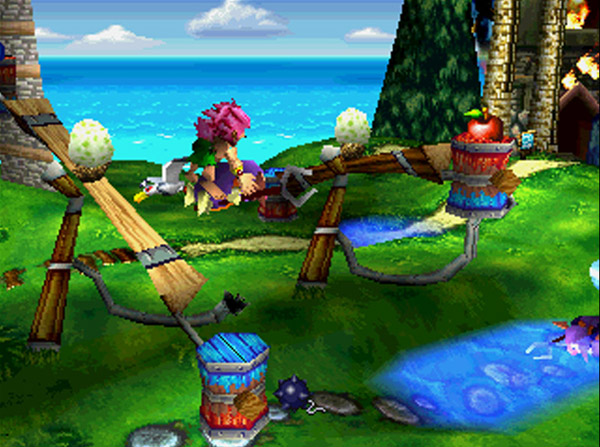
The word I've heard used most often to describe the overall aesthetic of Tomba is "cute." Indeed, the game exudes cuteness in a way that only anime could. Character designs will appeal especially to young gamers, but are universal enough to appease anyone looking for a platform style game with an abundance of sweetness and light. One of Tokuro Fujiwara's goals was to appeal to a large target audience with Tomba and he has succeeded without a doubt in my mind. At the very heart of Tomba is the game's platform engine which animates 2-D sprites on top of colorful 3-D backgrounds. While the combination of sprites and polygons for platformers breaks no new ground, Tomba makes good use of both to masterfully create a seamless side-scrolling experience. Tomba's character animation has lots of personality. Distinct action from the way he dashes (on all fours, no less) off cliffs to barely hang off an adjacent ledge, or how Tomba attacks his enemies with a variety of methods and weapons. Like all eye-catching sprite based platform games, Tomba has a lot of animated details which help bring life to the characters. In a few situations, other 2-D techniques such as sprite scaling and rotation were appropriately employed to great effect. Tomba's 3-D backgrounds are a perfect compliment to the 2-D sprites. As you maneuver Tomba through the often perilous landscape, the stage scrolls with a nice sense of depth and parallax. There are polygons from the background which also animate when Tomba interacts with it. Most buildings and houses are 3-D, thus allowing Whoopee Camp to construct an entire level based around the 4 sides of a Haunted Mansion. There is a limited amount of z-axis movement through each stage to allow players movement between the foreground and background. While this feature extends the size of the stage, it can also cause confusion as to whether or not something is in the foreground or the background. I've sent Tomba plummeting to his death on more than a few occasions because I misjudged a landing spot that was actually in the foreground. Overall, Tomba's graphics are fresh and hilarious and in a word - polished. It was an artistic endeavor through each stage of the planning process, to be sure.

While the sound effects are good, they are for the most part, unmemorable. Tomba is an amazing game in a genre starved of good solid titles, it is a shame that sound effects were somewhat of a letdown. Classic sound effects are timeless. I can still conjure up the jingling of the rings in Sonic the Hedgehog or the skidding sound Mario made when you made him go 180 the other direction. Don't get me wrong, Tomba's sound effects aren't ineffectual, they're just bland. Occasionally, there is nice background ambient noise and this impressed me as a definite improvement over other platform action games, but unfortunately, background noise tends to work itself into the blender of music and graphics - it is the sharp resonance of good sound effects that completes the overall experience. Surely, this is a nitpick. Players' mileage will vary with the sound effects and in the end, Tomba is still a very good game. The music also seemed to be from the school of Playstation synth-chip organ grinder carnival tunes. Sure, it's appropriate and quite often very good, but it's also pure evil on your subconscious. I can remember leaving Tomba on idle for hours and hours during the, ahem, research for this review and Tomba's repetitious melodies were at once zenful and sinful. Like a sweaty clown dripping with so much happiness and joy his makeup melts down the stubbled side of his face and becomes the vision of something horribly awry, Tomba's music will drive gamers to new heights of video game madness.

If there's one issue I feel that needs addressing with Tomba, the one quibble in an infinitely deep well of everything good and refined, it's the structure of the main quest. I don't mind linearity in a platform game because frankly, non-linear affairs often lose sight of itself even while it boasts limitless amounts of possibilities and an indefinite amount of total playtime. By the fifth or sixth hour of not knowing where to go next, what to do next, most people tend to take a permanent break. However, Tomba's quests often require you to go back and forth between areas, whether its in pursuit of one of the seven evil swine or in trying to complete a subquest. Whoopee Camp has lessened the hassle of taking notes (uh wait, what did the funny guy with no pants say to me again?) by providing us with an auto-notation system complete with color codes, to show at a glance, which quests have been completed and which quests have not. But like other games of this nature (Dracula X for instance), going back and forth often among the five areas can cause a considerable amount of confusion and not least of all, boredom. This can be a serious problem in a game that boasts "over 100 hours of gameplay." No doubt, you will get stuck. Some of the puzzles won't make any sense. You'll bang your head against your Dual Shock at the simplicity of some of the subquests. But rest assured, all your negativity will subside as soon as you're back in Tomba's world of 3-D platforms and 2-D pigs. Like I said, the gameplay is so spot on you quickly forget what it was you were so angstful about back in Mushroom Forest.

I can't stress enough just how special and how significant a title like Tomba is to the Playstation. It defies all accusations of an industry clamoring for that quick consumer buck. Tomba will dazzle you. You will fall in love with this game and you will rave about it to your friends. Indeed, it is a game worthy of all this praise, and perhaps even all my gratuitous hyperbole's. I can't wait to see what Whoopee Camp has in store for an encore.

-- Che Chou

Gaming Age Online is Copyright © 1997. All Rights Reserved.