
Publisher: GungHo
Developer: Game Arts
Medium: Digital
Players: 1-2
Online: Leaderboards
ESRB: T
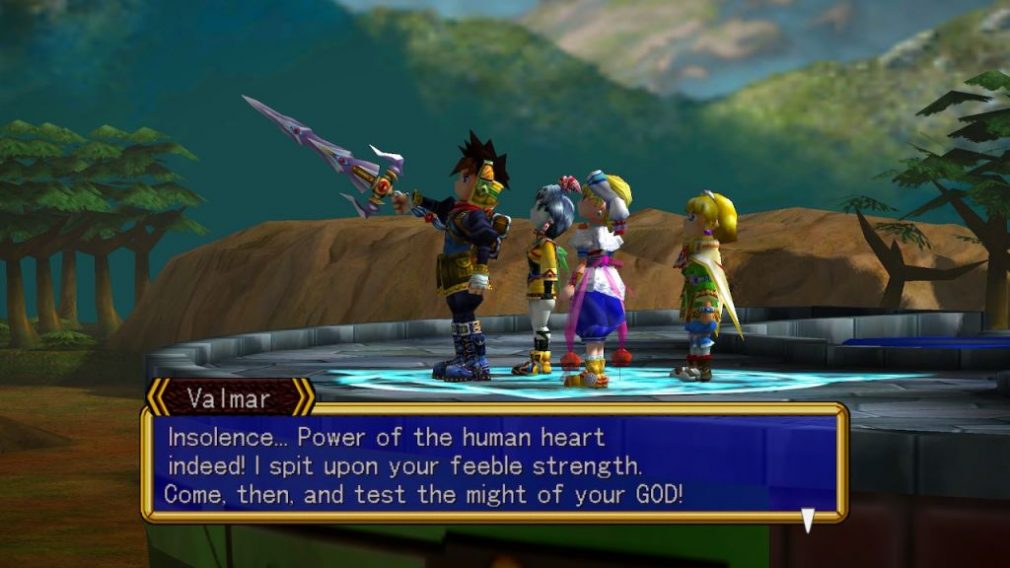
First released on the Sega Saturn in 1997 the original Grandia follows Justin, Sue and Feena on a grand adventure around the world searching for the lost civilization of Angelou. Grandia II originally released on the Dreamcast in 2000 follows Ryudo, and Elena as they attempt to seal away the dark god Valmar. Both adventures are now available on Switch, thanks to GungHo Online Entertainment, with the original Grandia coming to PC soon as well.
Being that Grandia is one of my all-time favorite JRPGs, when the HD collection was announced, I was excited to say the least. At the time, the battle system was one of the more complex and unique systems which encouraged players to do more than just attack all the time. The story started very childish but it grows on you and becomes a very long, grand adventure by the end.
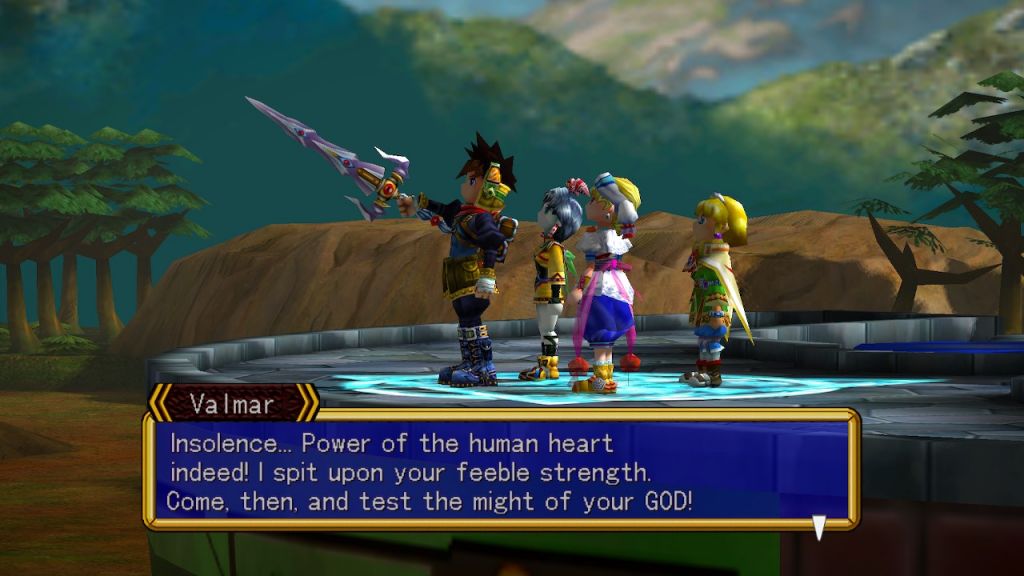
The story follows Justin and Sue ages 14 and 8 after they have taken up a challenge with a boy in town named Gantz. The challenge is rather childish, if Justin and Sue cannot find the Legendary Armor (a dirty apron) the Spirit Sword (a wooden sword) the Warriors Helmet (old pot) and the Shield of Light (pot lid) by sundown, Sue must marry Gantz. It starts very childish, and it is cute and fun in its own way. Early on, we find out that Sue is an orphan and Justin?s father died, leaving Justin a spirit stone. Spirit stones are supposed to be a myth but on a trip to an archeological dig site being run by the military, Justin?s spirit stone activated a door deep in the ruins and there he met Liete of Alent. Liete tells Justin of the ancient Angelou civilization and directs him to cross the ocean to look for Angelou. During the crossing he meets with Feena, another adventurer and they begin traveling to find Angelou. As the story progresses, the characters mature, granted with Justin it does take a while.
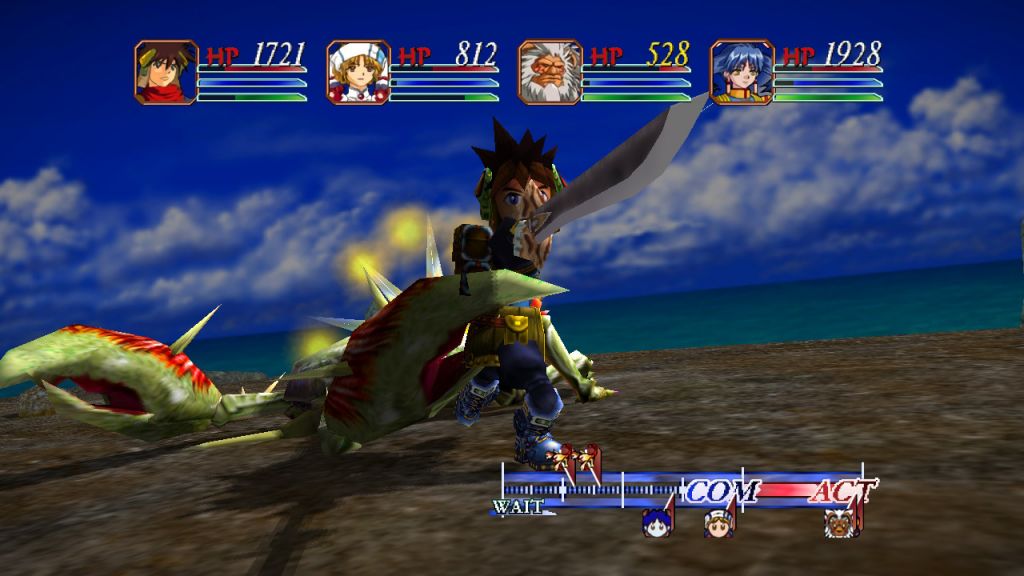
The Grandia battle system is one of the more unique systems for its time. There is an action gauge at the bottom of the screen, and on it is a portrait of each unit in battle. Their portrait moves along the bar until it reaches com (or command). At this point players can enter a command for the character. Once the command is entered, the portrait moves along the bar until it reaches act. When act is reached, the unit acts and does its action. Basic attacks are instant, abilities are not. When an ability or magic is used, their portrait moves slowly from com to act and each ability and magic spell has stars next to it. When they are used, the stars fill up and the more the stars an ability has the faster your character will act.
Each weapon type has its own experience point system. The higher the weapon level the more the character needs to use it to level up. Every time the weapon level hits 100 points, it levels up, new moves might be learned and the gauge starts again. Some moves require multiple levels in multiple weapons in order to learn. Same thing happens for magic. During their journeys mana eggs will be found. They can be traded in for one character to learn an element of magic. Water, Earth, Wind and Fire. Using magic in battle also allows for experience to be gained in that element of magic. As magic elements level up new spells are learned. Eventually, elements can be combined, earth and fire combine for explosion magic, for example, as well as wind and water for ice. Each element can be combined with one of two elements, fire and water will not combine as earth and wind will not.
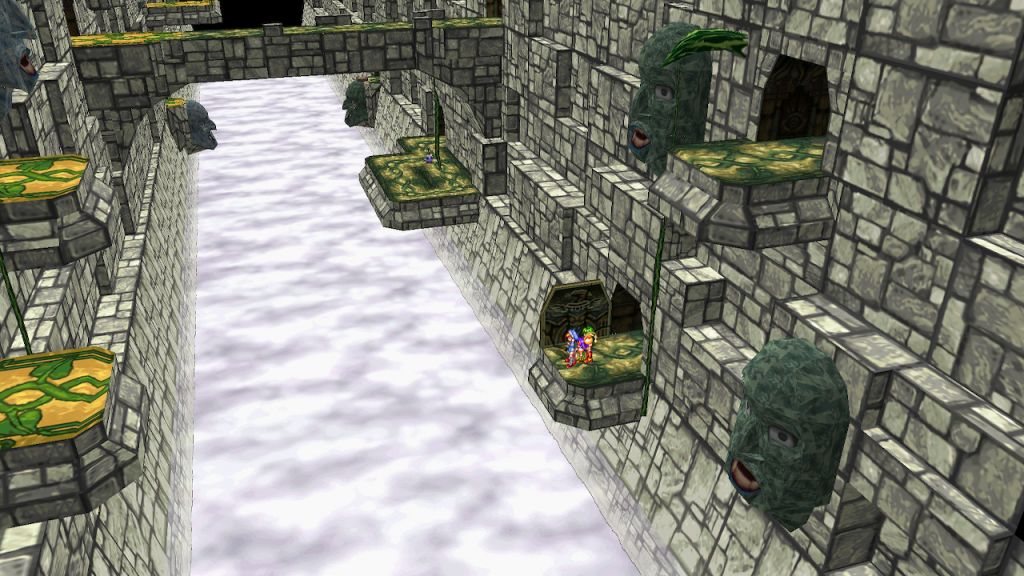
The HD Collection does a good job of visually updating the original game. The backgrounds and spell effects are all rendered in 3d while the characters are still sprites. The opening movies look like they have been touched up as well. The textures and sprites have all been updated and look smooth. There were a few spots where there was a sound bug, and the sound skipped a beat, or having the boss music playing two times over each other. The other slight annoyance is the start of fights where the screen blinks black for an instant. Overall Grandia still remains one of the best JRPGs of its age and should be enjoyed.
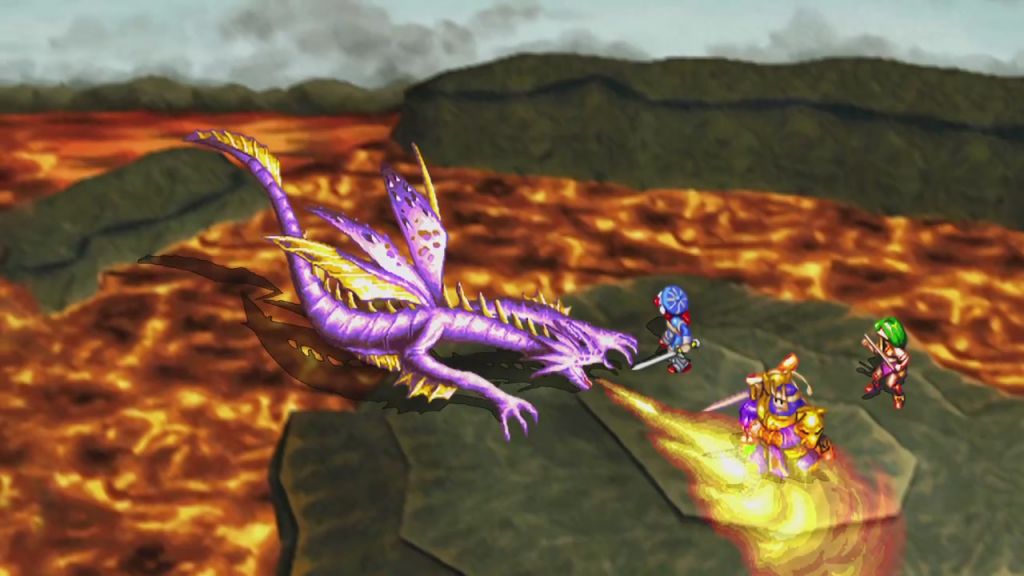
Grandia II follows the story of Ryudo, his falcon Skye and Elena as they travel the world to seal an evil god. Ryudo is a Geohound, a kind of mercenary that only takes up undesirable jobs. Thus, he is treated very poorly. He is kind of a jerk to most of the people he meets especially the people from the church of Granis (the god of good). The game is more mature than the original, and the main character is 17 instead of 14 like the last game and has a very brash attitude. At the beginning of the game it is going to rub people the wrong way. Most JRPGs of this type, the main character will do something for the town just because it?s the right thing to do. He will do it for the money, and the money only.
The battle system is very similar to the first game. The action bar is at the bottom, the stars on the abilities and magic are there, however, the way you earn more is completely different. As Grandia II progresses, players receive mana eggs, like in the first. But in this one they are equipped, and spells are then given to the characters. During battle, special and magic coins are dropped by enemies and can be used to upgrade mana eggs to not only learn new abilities and spells but also make them better.
Grandia II didn?t get much of a visual touch up overall. The intro video is extremely pixelated almost to the point of not being able to tell what?s going on in them. Some of the spell effects are just videos placed over the game, and also when these particular spells are used, the enemies will sometimes disappear off the screen, even though they are being hit. Other spells such as burn, create a fireball over the characters head. The lighting from it is very poorly done and could have been touched up easily. It is rather disappointing that Grandia II seems to not have gotten the care the first one did in this collection.
The voice acting in both games are available in both English and Japanese and as with most games of this era, the English voice acting can be bad to downright painful. The Japanese voice acting is much better. In the game selection menu players can choose between the two, however, there is a giant issue. There isn?t a way to switch between games without completely quitting and relaunching the full Grandia HD Collection. What?s even worse, if players want to change languages in Grandia II they also have to exit out of the collection again to switch, whereas the original Grandia has the option in game. This is extremely disappointing.
Overall the Grandia HD Collection is a good one, and if you enjoyed the original game, this is a great version of the release. Grandia II by comparison didn?t get much in terms of upgrades aside from the Japanese voice acting, so it pulls down the overall package somewhat.
Note: PUBLISHER provided us with a GAMENAME SYSTEM code/copy for review purposes.