
Publisher: Gearbox Software
Developer: Gearbox Software
Medium: Digital/Disc
Players: Multi
Online: Online
ESRB: E10+
A small rant on remastered games and how game companies are treating their fans.
HD remakes have been coming out seemingly faster than new, unique gaming titles. Is it healthy for the gaming industry to release games that appeared on last gen consoles this generation? Especially only a year out? *ahem* Dark Souls 2 *ahem* The Last of Us. What about games that have been released on the last 2 generations and coming out now *ahem* Final Fantasy X/X2 HD Remastered. Is it really worth gamers buying games if the publisher is only going to turn around and release an enhanced version a year later? Especially at a price that is at or close to the cost of a new game?
Gaming companies need to treat their fans better than what we are getting now. From Software is a great example of this. Why couldn’t they come out with the Xbox One and PS4 editions of Dark Souls 2 last March? Or at the very least announce that it was coming to current generation consoles when they released the original game? Give the gamer the opportunity to decide on which edition to get. Instead they spit in the face of people who purchased the original game just over a year ago by waiting eight months to announce that it was also coming to a new generation of consoles. On top of that, we find out that usually ALL of the DLC is also included along with these new versions. So people may have already spent as much as $90 to get the full experience of Dark Souls 2, only to find out that From Software/Bandai Namco is going to release the game at the full $60 price with everything included. Not even PC gamers are immune from this as From Software won’t even patch the PC version to give it the upgrades and enhancements without players spending a bit more money.
Game of the Year editions aren’t quite the same in my eyes, yes they re release the game with all of the DLC available, however, there is no graphical upgrade, nor is there usually any general improvements or content that was not available from the original release, aside from the DLC to the game itself. There are a few exceptions, the Kingdom Hearts HD remakes for example. Borderlands The Handsome Collection is coming out a year after The Pre-Sequel as an HD remaster of Borderlands 2 and Borderlands the Pre-Sequel. I have waited for GOTY editions of games to hit, I?m still waiting for the Mass Effect GOTY trilogy before I bite for example.
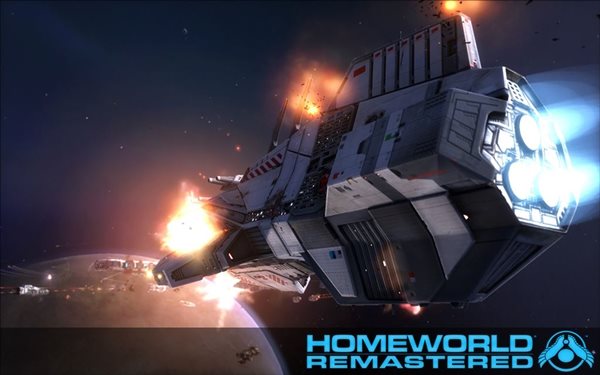
All this being said, there are games that deserve and could use a remaster and would seriously benefit from it (I’m looking at you Final Fantasy VII). A remaster is only effective if the original game looks like a whole new game with the re release, and the Homeworld Remastered Collection is a fantastic example of this! It doesn’t hurt that it is priced at what a remaster should be.
Homeworld Remastered Collection includes both Homeworld games, however, I will spend most of my time talking about the first game as it received the biggest overhaul. For those of you who haven?t played Homeworld 1 or 2, it is the first truly 3D RTS (real time strategy) game to come out. Up to this point if you played an RTS it was always played on a 2d plane, with some high and low terrain thrown in for good measure to make it feel like it is 3D. Homeworld?s battlefield is space, and all the hazards therein. The enemy could come at you from ANY angle, left, right, high, low. The only thing that could block your vision is your sensor range so make sure you build lots of probes.
The first Homeworld came out in September of 1999 and was almost an instant classic. Consisting of 16 missions, it chronicles the journey of your people, the Kushan to their real home planet of Hiigara. The Taiidan imprisoned the Kushan to the planet Kharak millennia ago, prohibiting them from developing FTL (Faster than light) travel. Over the years the treaty was forgotten by the Kushan and when they found the original colony ship that brought them there and a map that would lead them home to Hiigara, they built a mothership to carry them home. The Taiidan didn’t like this and so they sent a fleet to stop them.
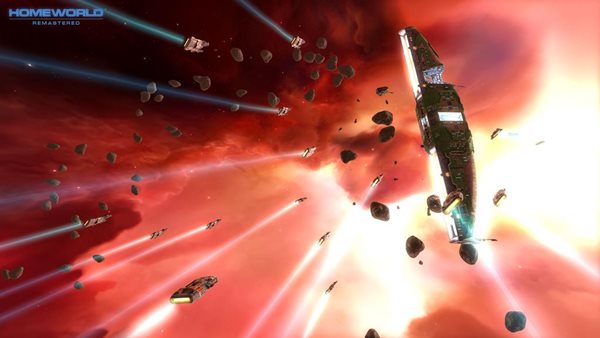
There are a couple of very unique features in Homeworld that were not found anywhere else in RTS games at the time. First and foremost, the full 3D battlefield and the ability to move ships along all 3 axis, x, y and z. The second was that your fleet and all of your resources carried over to the next fight. This means that Homeworld?s missions could get very boring once the main objectives of that mission have been completed. Players could jump out of the system and start the next mission, however if there are any resources still on the map that players haven?t collected, they would be missing out on basically free money. This could have been avoided by the ability to be able to speed up the game, or by the enemy in the next mission getting stronger the longer the player takes to collect resources.
The missions vary from destroy the enemy fleet, to capture a well-guarded vessel, to survive an asteroid field, etc. Just because you are in space doesn’t mean the missions can?t be varied. All the first few missions consist of kill everything in sight, but don?t let that get you down as the variety does start to get better as the game goes on.
The controls in Homeworld were very intuitive at the time of the original release, and they still are. Shortcuts can be changed whenever the players want to. Groups can be assigned much like they can be in all other RTS games. To move your fleet up and down, players have to hold the shift key when making a move command for their fleet.
The Kushan have only one mothership, if their mothership gets destroyed, it?s game over. The mothership is what builds all other ships, from tiny fighters to massive capital ships, and it is not the only vessel that can build a fleet. Capital ships can build fighters up to frigates and be a part of their own assault fleet. This means that in multiplayer battles, as long as you have a capital ship, the fight continues. In single player, if the mothership explodes, the game is over.
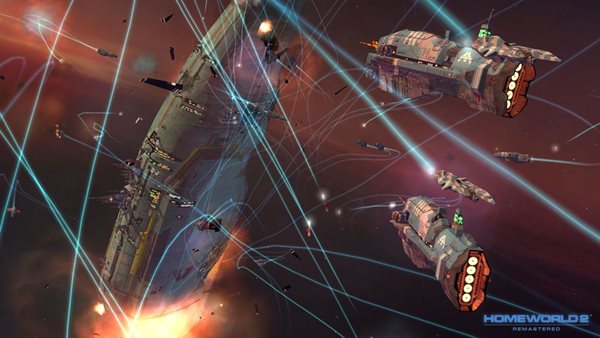
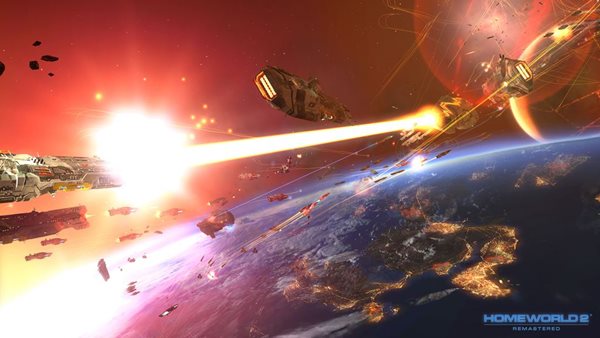
The upgrades and enhancements in Homeworld are definitely significant! Gearbox, which purchased the rights when THQ went under, did a wonderful job of bringing the game current. The textures are nice and crisp, the ships look fantastic. The sound track ranges from great somber melodies when players are exploring, to fantastic orchestrated battle music when engaging. Just like the original, the Homeworld Remastered Collection does not disappoint!
Players who purchase the Homeworld Remastered Collection, get both the remastered and the original Homeworld games, plus many of the popular mods that were created for the Homeworld series (such as the complex mod for Homeworld 2), which is huge! There are mods everywhere for the Homeworld series, everything from making the game more complex, to changing the game to look like it?s from your favorite sci fi series (Star Wars, Babylon 5, Battlestar Galactica, etc), so that?s a great plus.
Homeworld was, at the time, my favorite RTS. With the release of Homeworld Remastered Collection, this game has crawled back into my heart and is now firmly planted there for quite some time to come. Homeworld was one of the games I have such fond memories of — staying up late every night to play with or against my best friend, destroying the computer, or going up against other human players online. At $35 or so, PC gamers and RTS fans cannot go wrong with Homeworld Remastered Collection!